
Home / Solutions / Construction-site hazards
Train the eye for site hazards - before they cause harm
With VR construction safety training, your people practise what a real site can hardly teach safely: noise control, site wastewater, an oil spill. HSE training (health, safety and environment) built on what is likely the world's largest VR hazard library, co-created with Campus Sursee.
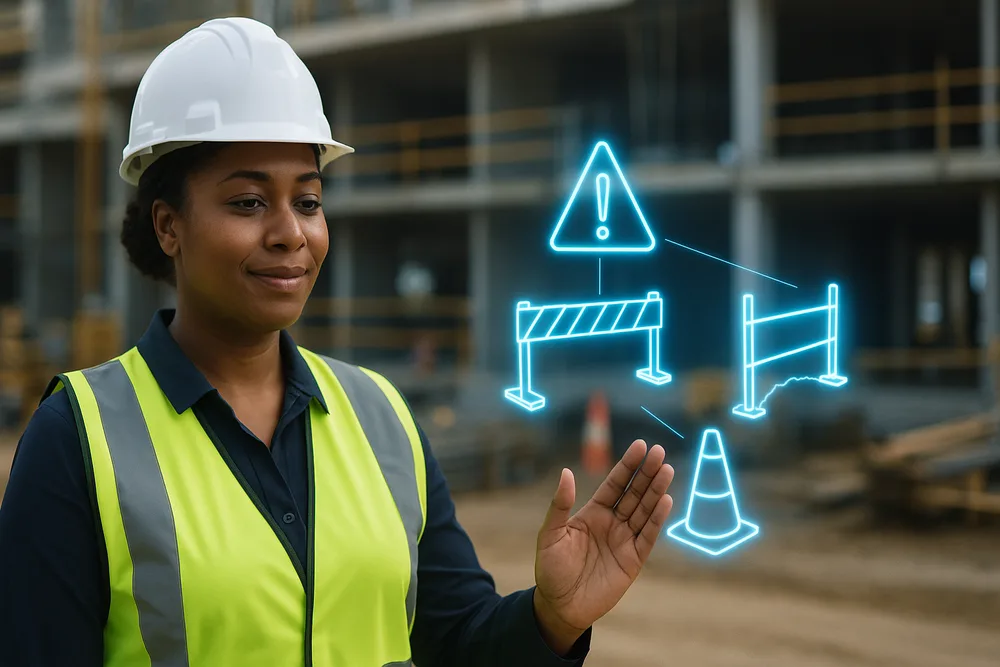
Construction sites are full of hazards you can't safely recreate for training. Workers too often learn to spot them only through near-misses. With VR training, they learn this on a virtual construction site, before they meet the hazards for real.
Watch on YouTube: VR safety training for the accidents you cannot rehearse
HSE on the construction site: health, safety and environment, practised in VR
The training comes from the VR Umwelthalle, a virtual construction site that AtlasVR developed with Campus Sursee. Each module stands alone and fits into existing courses and HSE training (in the US often called EHS).
Measure and reduce noise
Measure with a decibel meter how enclosures, distance, noise barriers, gaps and materials change the level, and derive measures that work.
Sort site waste, test asphalt
Sort construction waste into separate skips, test reclaimed asphalt for tar (PAH) with the indicator spray and match the recycled mineral aggregates to where they may be used.
Treat site wastewater
Why construction wastewater is turbid and alkaline, how a water treatment plant settles and neutralises it, and where it belongs: in the foul sewer, never in the surface-water drain.
Run a water treatment plant
Calibrate the pH probe with two buffer solutions, change the CO₂ cylinder safely and put the plant into operation. The follow-on module to site wastewater.
Oil spill: report first, then bind
Oil on the ground: alert the police or fire service, apply oil absorbent, spread it, let it bind, sweep it up and collect it in a sealed container. Oil on water: absorbent made for water and a skimmer. Used absorbent is hazardous waste.
Hazardous substances and GHS symbols
Read the nine GHS hazard symbols and store hazardous materials correctly: that is a module of its own. VR training for hazardous materials
Related modules: fall protection (upcoming) and the crane simulator.
How the training runs
The modules are for training centers, construction companies and safety officers. Use them at vocational school or in a training center, or roll them out in your company.
Individual and guided
Each person trains individually in a VR headset, guided by audio instructions and with immediate feedback, for around 45 to 60 minutes per module. The hazards exist only in VR: nobody gets hurt and nothing is damaged.
Reflection and record
An optional reflection straight after carries the lessons over to your own site. Every completed training run is reported to the AtlasVR Dashboard, which can be switched off on request. A training record is available on request.
Delivered turnkey
The training runs on Meta Quest 3 and 3S, or on the Pico 4 Ultra Enterprise on request. AtlasVR ships the VR headsets pre-configured and handles rollout and maintenance, so no XR or IT expertise is needed on your side.
Languages: German; the water treatment plant module also in English, French and Italian. English for every module and more languages on request.
In use at Campus Sursee
The portfolio
AtlasVR developed the VR Umwelthalle with Campus Sursee: what is likely the world's largest VR content portfolio for construction-site hazards. The real Umwelthalle stands on the Campus Sursee site, and the VR version is in use there. The Swiss Federal Office for the Environment (FOEN) and the Albert Koechlin Stiftung supported the project.
We build it. You roll it out.
AtlasVR co-creates its training with the associations and training centers that set the standards in their trade. The partner gets the right to use the content and roll it out - the model behind Campus Sursee's construction-hazard portfolio. Talk to us about co-creating a module for your trade.
Common questions
With VR training from AtlasVR, co-created with Campus Sursee: your people practise on a virtual construction site what a real site can hardly teach safely - measuring and reducing noise, sorting waste, treating site wastewater, running a water treatment plant and handling an oil spill. Because the hazards exist only in VR, they can practise as often as needed and nobody gets hurt.
Report first, then bind: alert the police or fire service, apply oil absorbent, spread it with a broom, let it bind, sweep it up and put it in a sealed container. Used absorbent is hazardous waste. On water, use absorbent made for water and a skimmer; booms are a job for specialists. This is exactly the sequence your people practise in the VR training.
HSE stands for health, safety and environment; in the US the same field is often called EHS. On a construction site it covers protecting people from noise, hazards and emergencies, and protecting the environment from waste, wastewater, oil and hazardous substances. AtlasVR's VR modules let your people practise both sides hands-on.
Co-created with Campus Sursee, it is what is likely the world's largest VR content portfolio for construction-site hazards: noise, recycling and circular construction, site drainage, the water treatment plant, oil spills, and hazardous substances and GHS symbols.
Meta Quest 3 or 3S as standard, or the Pico 4 Ultra Enterprise on request. AtlasVR ships the VR headsets pre-configured and ready to use, and handles rollout and maintenance.
Every completed training run is reported to the AtlasVR Dashboard; this can be switched off on request. A training record is available on request.
German; the water treatment plant module also in English, French and Italian. On request, every module is available in English and in more languages.
Bring this module to your team
Book a demo and see this module in action on your own procedures.